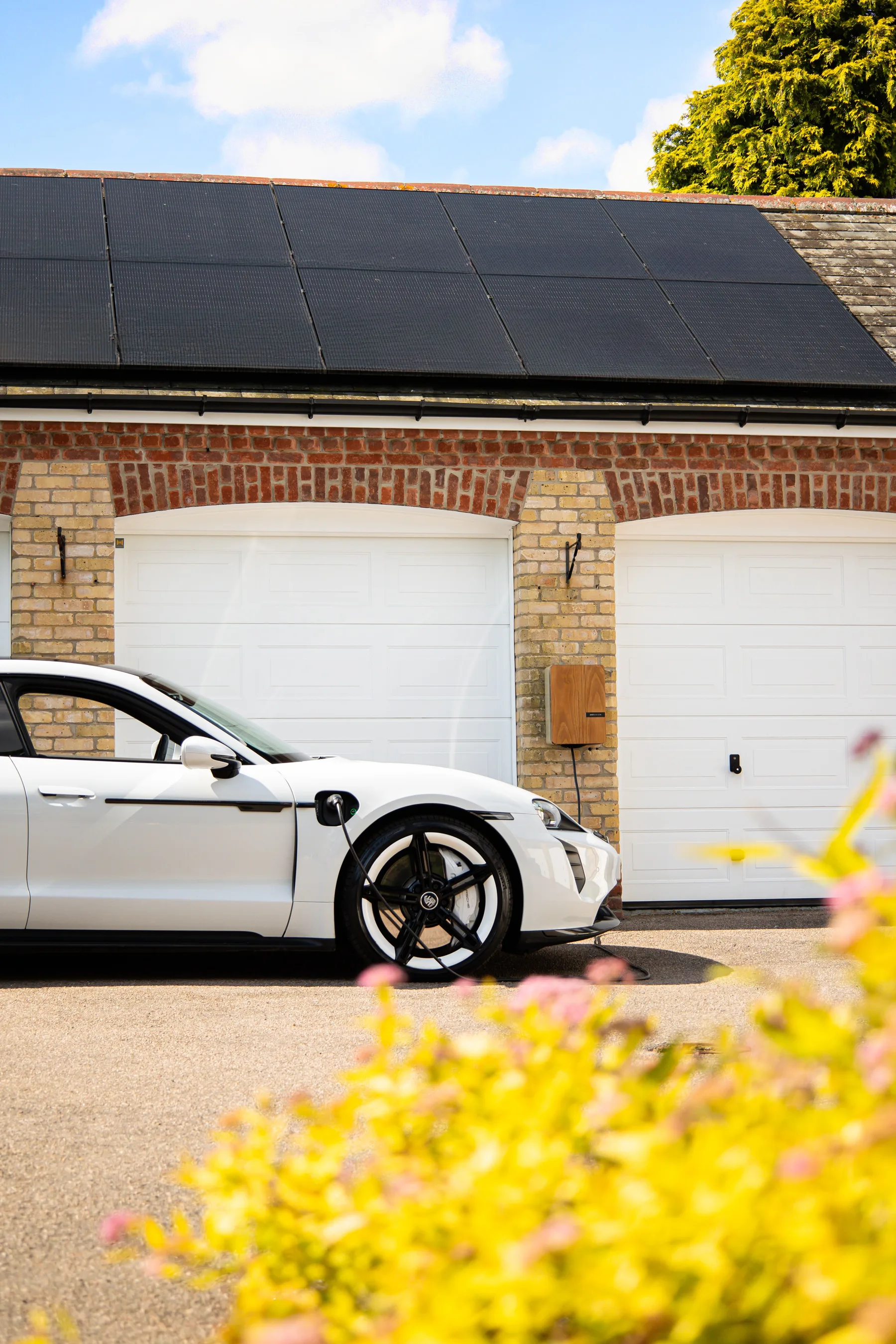
Home EV charging
Level 2 home charging, installed and inspected properly.
A Level 2 home charger runs on a 240-volt circuit and adds roughly 25 to 40 miles of range per hour, against about 4 from an ordinary household outlet. For most drivers that is the difference between charging overnight and never quite catching up.
The install is an electrical job, not an appliance delivery. It needs a dedicated circuit, appropriately sized conductors, a breaker your panel has room for, and a permit and inspection in every city in the Valley. The part that decides the price is almost always the distance from your main panel to where the car parks, and whether that panel has capacity left.
If it does not, there are options short of a full service upgrade — load management devices can let a charger share capacity with existing loads. We will tell you which applies to your panel before quoting.
The instant calculator on our home page models single-family rooftop solar only. For ev charging, the useful next step is a conversation.
What the job includes
- Panel capacity check and a load calculation
- Dedicated 240 V circuit, conduit and conductors sized to the charger
- Charger mounting and connection, indoor or outdoor rated as needed
- Permit and electrical inspection
- Load management equipment where the panel is at capacity
Worth knowing before you buy
- Do I need to upgrade my electrical panel?
- Not always. Many homes have enough spare capacity for a 40 or 48 amp circuit, and where they do not, a load management device can often avoid a service upgrade by pausing the charger when the house is drawing heavily. A load calculation answers this properly, and it is part of the assessment.
- Can it run off my solar?
- Yes, in the sense that a car charging during daylight uses your own production rather than importing. That is worth more under net billing than exporting the same energy. Scheduling the charge for the middle of the day is the simplest way to get that benefit.
- Does the install need a permit?
- Yes. Every jurisdiction in the San Fernando Valley requires a permit and inspection for a new 240 V circuit. An installer who offers to skip it is offering you an unpermitted circuit on your own house.
Your home. Your energy. Your future.
Find out what your home could save in about a minute.